


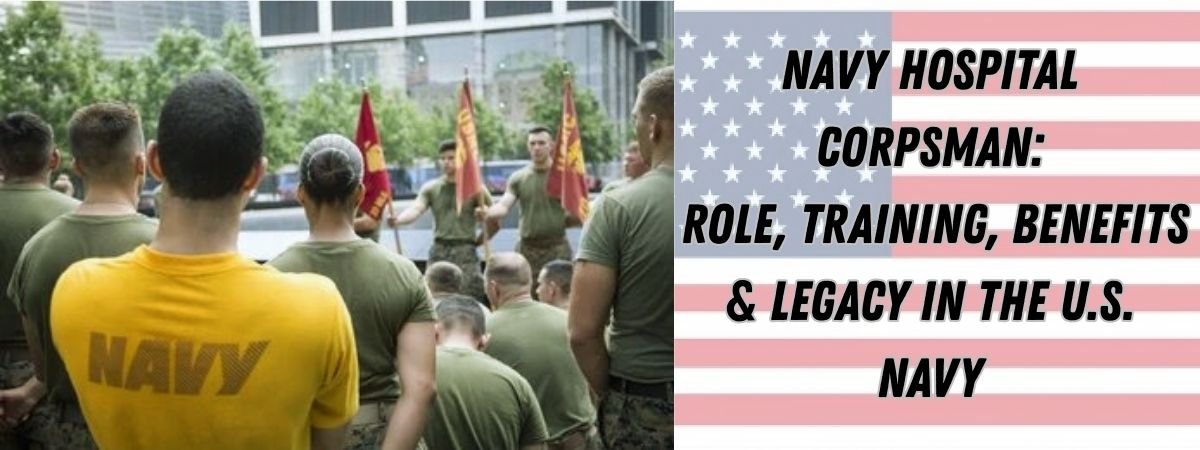
What is a Navy Hospital Corpsman?
A Navy Hospital Corpsman (HM) is an enlisted medical specialist in the U.S. Navy. HMs serve in many environments — aboard ships and submarines, on shore (hospitals or clinics), or embedded with Marine Corps units. They’re trained to handle everything from routine care to emergencies in combat.
Many consider them “medics,” but in the Navy they’re officially “corpsmen” — and their scope often goes beyond what many associate with “medic.”
A Brief History of the Navy Hospital Corpsman
- The Navy Hospital Corps was officially created on June 17, 1898.
- Over decades, the corps name and structure changed. Terms like “hospital apprentice,” “pharmacist’s mate” eventually gave way to the modern “Hospital Corpsman”.
- HMs have served in every major conflict: WWI, WWII, Korea, Vietnam, Gulf War, Iraq, Afghanistan.
- It’s the most decorated enlisted rating in the Navy. There are dozens of Medals of Honor, Navy Crosses, Silver and Bronze Stars awarded to corpsmen over time.
- This legacy brings pride and a heavy sense of responsibility.
Core Duties of a Navy Hospital Corpsman
HMs cover a huge range of medical duties, depending on their assignment (ship, hospital, Marines). Some examples:
- Routine medical care: Physical exams, immunizations, lab tests, dentistry support, basic patient care.
- Emergency & combat medical support: On the battlefield with Marines, providing first aid, triage, stabilization, evacuation care.
- Independent duty roles: On ships/submarines, remote duty stations where no doctor is available — corpsmen may act as primary medical provider.
- Specialty support: Lab work, radiology, pharmacy, surgery assistance, preventive medicine, public health. Because of this breadth, many corpsmen say they never get “stuck” doing just one kind of work — there’s always variety.
Training and Education: How to Become a Navy Corpsman
After Navy basic training, corpsman trainees attend medical training (what used to be “Hospital Corps School”). Today that’s often conducted at a joint military medical education campus.
Basic training covers medical fundamentals: first aid, anatomy/physiology, patient care, emergency medicine basics. Corpsmen may then get additional “C school” training to specialize (lab tech, radiology, surgery support, etc.).
For those destined for Marine Corps attached units or special duty (ships, subs, remote stations), there may be additional field training.
Over time, with experience and promotion, a corpsman can rise to senior enlisted levels (Chief Petty Officer 3rd Class, etc.) and take leadership or supervisory roles. Recent examples in 2025 show corpsmen selected for senior enlisted ranks
Career Path and Opportunities for Navy Corpsmen
Corpsmen keep the medical backbone of the Navy strong: ships, submarines, Marine units, hospitals. Without them, many missions simply couldn’t happen.
They offer flexibility: you might work in a hospital one tour, aboard a ship the next, and then with Marines after that. It’s not a “desk job.”
The career builds real medical skills — useful even outside the military. Many former corpsmen transition to civilian medical careers.
Corpsmen carry a legacy of bravery, resilience, and service. The honors and decorations reflect that history.
Navy Corpsman vs. Army Medic: What’s the Difference?
The term “medic” is often used broadly. But in U.S. military context:
- “Corpsman” refers to Navy (sometimes Coast Guard) enlisted medical personnel. By Wikipedia
- Other branches (Army, Air Force) use “medic,” “combat medic,” or other titles. Their training and duties can overlap, but corpsmen often have broader medical training and serve in more varied roles (hospital care, shipboard care, labs, etc.).
- Many corpsmen believe their scope and versatility sets them apart from a narrow‑role “medic.”
Who Should Consider Becoming a Navy Corpsman?
If you like helping people, are interested in medicine or healthcare, can handle pressure (combat/field or emergencies), and are open to varied duty (ship, shore, field with Marines), this job could fit well. It offers training, a sense of service, and a path that can translate to civilian medical jobs later.
Leave a Comment